The lead data engineer vacancy opened two months ago. There are plenty of applications, but the right person is not among them: some lack the experience, some want to switch careers, and some applied to everything in sight. Meanwhile, the person you actually need is working quietly at another company and is not looking at job ads. Expert hiring stalls not because there are too few resumes, but because strong specialists rarely look for work themselves. You have to find them, assess them clearly and catch their interest before your competitors do.
One channel is not enough for that. You need to combine applications, cold search across resume databases and professional platforms, a personal first contact and fast assessment in a single process, so that no suitable candidate gets lost between a spreadsheet, email and a messenger. Below we look at where expert recruitment loses time and how HRStream structures it.
The short version
- Expert (targeted) hiring is a focused search for a specialist with a rare combination of skills, most often among people who are not currently looking for a job.
- The problem is not the number of resumes: in IT in Kazakhstan there are 8.8 resumes per vacancy (hh.kz, Q1 2025), but only a handful of them are a good fit.
- Timelines stretch into months: according to hh.ru, 43% of employers in Russia fill a vacancy in one to two months, and 15% take longer.
- Only the combination works: applications + cold search + a personal message + one clear assessment for every candidate.
- In HRStream these inputs come together in one funnel: AI screening of applications, cold search across 17 sources, an AI recruiter and AI interviews in messengers.
What expert hiring is and how it differs from high-volume hiring
Expert, or targeted, hiring is the search for one or two specialists with rare experience: developers, engineers, finance professionals, managers. Unlike high-volume hiring, where candidates come to you and speed of response decides the outcome, here you have to find and persuade most of the people yourself, and a wrong choice is expensive.
| Expert hiring | High-volume hiring | |
|---|---|---|
| Where candidates come from | Applications + active search: resume databases, LinkedIn, GitHub, referrals | Mostly applications |
| How many you need | One or two people per position | Dozens for similar positions |
| What decides the outcome | Accurate assessment and a personal approach | Speed of the first reply |
| Where time goes | Search, assessment, sign-off with the hiring manager | Initial review and phone screening |
Why experts are so hard to hire
An expert vacancy loses time in four places: a stream of the wrong applications, invisible passive candidates, slow assessment and a slow approval process.
1. Plenty of resumes, only a handful that fit
According to hh.kz, in Q1 2025 there were on average 8.8 resumes per IT vacancy in Kazakhstan, and 20 per CTO position (hh.kz). For 2025 as a whole, the IT competition index rose to 12.9 (DigitalBusiness.kz, based on hh.kz data). That sounds like a surplus of candidates, but it does not make the recruiter's life easier: every resume has to be read and checked against the requirements, and the good fits are still few. According to Talantix data for 2024, a skills mismatch was named as the reason in 34% of failed hires (Retail.ru, 2025, Russia).
2. Strong specialists do not apply
Someone who is valued in their current job does not browse vacancies. You can find them in a resume database, on professional platforms or through a public profile, but the recruiter has to reach out first, and personally. According to LinkedIn, personalized messages get replies about 15% more often than bulk messages, and short messages under 400 characters get replies 22% more often than average (LinkedIn, 2022).
3. Hiring drags on for months
According to hh.ru analytics for 2025, only 5% of employers in Russia fill a vacancy in the first week, 43% take one to two months and 15% take more than two (Delovoy Peterburg). Hiring difficulties are a global story: in ManpowerGroup's 2026 survey, 72% of employers across 41 countries reported them (ManpowerGroup).
4. Candidates are lost halfway
While a resume waits for feedback from the hiring manager and an offer waits for approval, the expert receives other offers. The more people are involved in the decision and the further they are from a shared system (email, personal chats, spreadsheets), the higher the risk of hearing "thanks, I've already accepted another offer".
How HRStream handles expert hiring
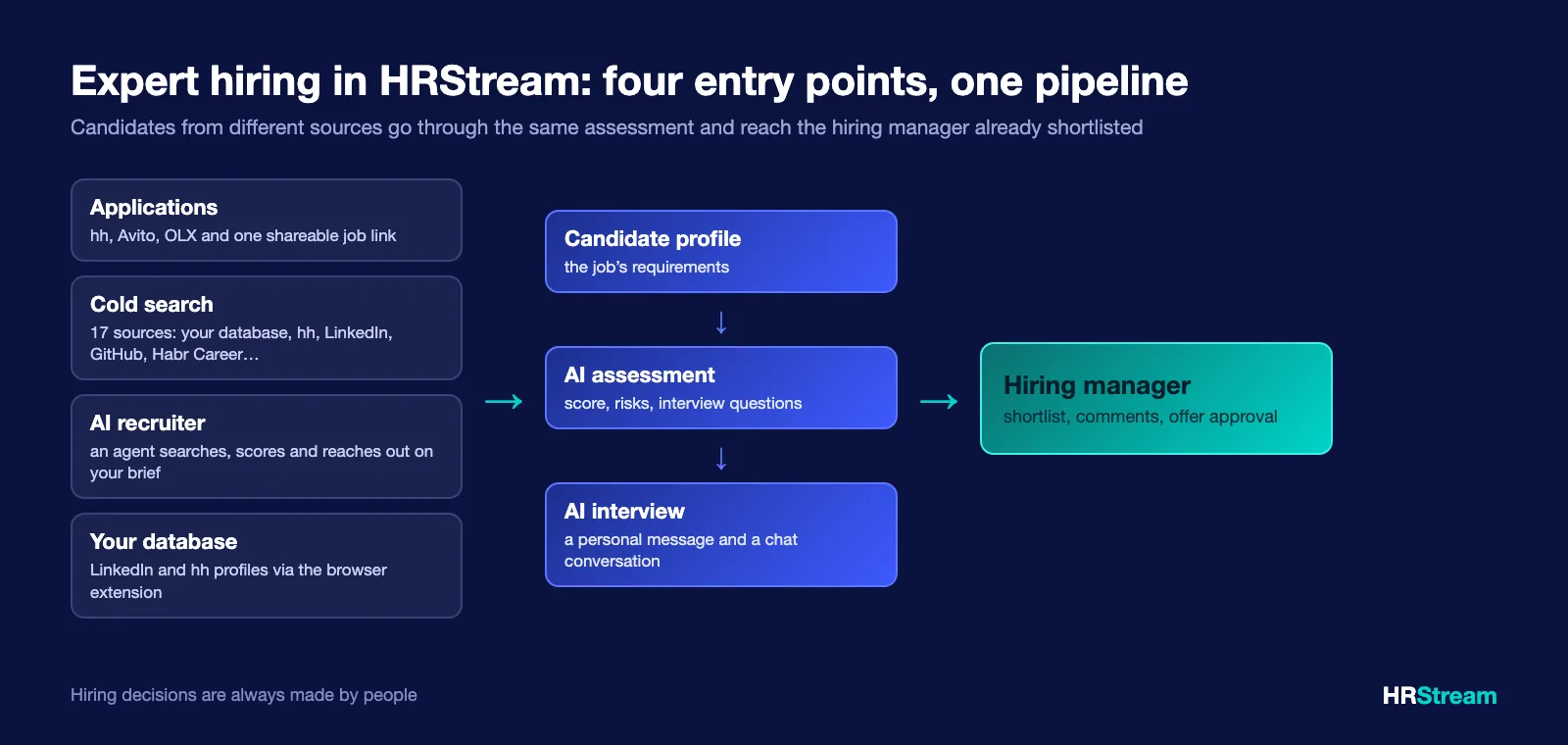
HRStream brings every way of finding an expert into one funnel and gives each candidate an equally clear assessment. The recruiter manages the search instead of switching between ten browser tabs.
Applications: AI screening instead of manual reading
Applications from HeadHunter, Avito and OLX (in Kazakhstan) land in the vacancy automatically. The system reads every resume, checks it against the requirements and gives a score with an explanation: strengths, risks, interview questions and a recommendation to invite, reject or think it over. The recruiter starts with the best fits rather than the earliest by date. More in the article on AI candidate screening.
Cold search: 17 sources in one window
When there are few applications, or the wrong ones, the recruiter runs a cold search. With a single query it searches your own HRStream database, HeadHunter, Avito, professional platforms (LinkedIn, Habr Career, GitHub, Behance, Dribbble, Stack Overflow, Kaggle) and public social media profiles. Profiles of the same person are merged, and candidates you already know get an "Already in database" tag. You can move the people you find into the vacancy, while contacts from HeadHunter and Avito are only revealed after you confirm. How it works is covered in the article on candidate sourcing: 17 sources.
AI recruiter: a search built around your task
You can simply describe the task to the agent in one phrase: "need a lead data engineer, Almaty, hybrid". The agent prepares the vacancy, the candidate profile and the first message, finds candidates in HeadHunter, the HRStream database and Avito, scores each one with a rationale and builds a shortlist. You decide how independent it is: shortlist only, working with your approval, or autopilot with limits. Decisions that cannot be made automatically go to the "Needs your decision" queue. Details are in the article on the HRStream AI recruiter.
Personal first contact and AI interview
Experts get a personal message on WhatsApp, not a templated mass mailing. In the first message the agent says it is an AI assistant and lets the person end the conversation with the word "stop". After that, the AI interviewer can hold a short conversation based on the vacancy script in WhatsApp, Telegram, Max, by email or in the HeadHunter chat, clarifying experience, expectations and readiness to move. The recruiter gets a summary of the conversation and steps in once the candidate is interested.
Candidate profile and team in one system
The requirements for the candidate are captured in the candidate profile for the vacancy, and every source is assessed against it in the same way. Hiring managers and stakeholders work in the same system: they see candidates, leave comments with @mentions and approve offers through a configured process. The browser extension saves profiles from LinkedIn and HeadHunter to your database in one click, so a specialist you found once is not lost and can be useful for the next vacancy.
An honest caveat: AI does not hire the expert for you. It takes on the search, initial assessment and routine messaging, and leaves the conversation about the work, the skills check and the decision to people.
Example: a lead data engineer in a few weeks instead of months
A typical situation (a composite example, not a specific client case): a fintech company in Almaty is looking for a lead data engineer. The vacancy on hh.kz received 60 applications, two of which fit, and both are in the final stage with other companies.
- The usual way: the recruiter reads all 60 resumes, searches LinkedIn and GitHub by hand and messages people from a personal Telegram account. The head of data replies about candidates once a week, and two months later the vacancy is still open.
- With a single funnel: applications are sorted by score straight away, a cold search across databases and professional platforms runs in parallel, and the agent builds an additional shortlist from HeadHunter. Every selected candidate gets a personal message, and those who are interested take a short AI interview. The head of data sees candidates with scores in the system and approves them in the candidate card without waiting for the weekly meeting.
The difference is that search, assessment and decisions run in parallel rather than one after another.
Expert hiring checklist
- The candidate requirements are written down and agreed with the hiring manager before the search starts.
- You do not wait for applications: cold search across databases and professional platforms runs from day one.
- Every passive candidate gets a short, personal message with specifics about the role, not a template.
- Candidates from applications, the database and cold search are assessed against the same criteria.
- The hiring manager gives feedback in the system within days, not weeks.
- Strong candidates who decline now stay in the database for the next vacancy.
How to link these steps into one process is covered in the article on how to build a hiring funnel.
Frequently asked questions
How is expert recruitment different from high-volume hiring?
In high-volume hiring candidates come to you, and the main thing is to reply quickly and filter out those who do not fit. In expert hiring there are few suitable people, most of them are not looking for work, so active search, accurate assessment and a personal approach to each person matter most.
Where do you find a niche specialist who is not among the applicants?
In resume databases (HeadHunter), on professional platforms such as LinkedIn, GitHub, Habr Career and Behance, and in your own database of candidates from past vacancies. It is easier when the search across these sources runs from one window and the people you find go straight into the vacancy.
How do you message a passive candidate so they reply?
Keep it short, personal and to the point: why you are writing to them specifically, what the role is and what makes it interesting. According to LinkedIn, personalized messages get replies noticeably more often than bulk ones, and short messages more often than long ones.
How long does it take to fill an expert vacancy?
Usually from one to several months: according to hh.ru, 43% of employers in Russia fill a vacancy in one to two months, and 15% take longer than two. Parallel search across several channels and fast feedback from the hiring manager help shorten the timeline.
Can you trust AI with expert search?
With the routine, yes: searching databases, initial resume screening, the first message and a short chat interview. Assessing the candidate's level, discussing the work and making the hiring decision are better left to people. In HRStream you choose how independently the AI recruiter works.
When should you use a recruitment agency and when should you search yourself?
An agency makes sense for one-off complex searches if the company has no recruiter. If you have several expert vacancies a quarter, it pays to build your own process: a candidate database, cold search and a single funnel that stay with the company.
Let's talk about your expert hiring
We will show how applications, cold search across 17 sources, the AI recruiter and AI interviews come together in one funnel for your vacancy in HRStream.